
Venezuela Isn’t the Story. Decline Is.
Why America’s failure to build keeps turning into military action

This morning we woke up to reports that the United States went into Venezuela and captured Nicolás Maduro. This is a bigger story that we went in for oil. This is a story of America in decline.

If you are a Trump voter who bought the “no more wars” pitch, you should be furious. Not because you suddenly love Maduro, but because you were sold a brand and you are watching the fine print get shredded in real time.
No more foreign wars.
No more forever conflicts.
End the chaos.
Lower costs on day one.
Drain the swamp.
Now add another checkmark to the list of promises that did not materialize. The Epstein files are still not meaningfully transparent. The world did not calm down. Gaza did not resolve. Ukraine did not resolve. And instead of pulling back, we are putting boots and firepower into another country.
People can call this “an operation” or “law enforcement” or “narco-terrorism accountability.” Fine. But it is still a military action inside a sovereign nation, and it still contradicts what voters were told.
Now, the lazy explanation is “we went in for oil.”
That’s true, but it is also too small.
Replace “oil” with energy. Then add rare earth metals and strategic inputs. That is the real framework. That is the world we are in now. A world where the difference between stability and decline is who controls energy, minerals, and the industrial capacity to turn them into real products.
And here’s the part Americans do not want to admit.
We are not the country that builds anymore. So we use the only industry we healthily invest in (the military industrial complex) to take what we cannot build.
The U.S. Is Stagnant, China Is Scaling
If you spend any time online, you have seen those charts flying around. China’s power generation capacity versus the United States. Their curve goes up. Ours barely moves.
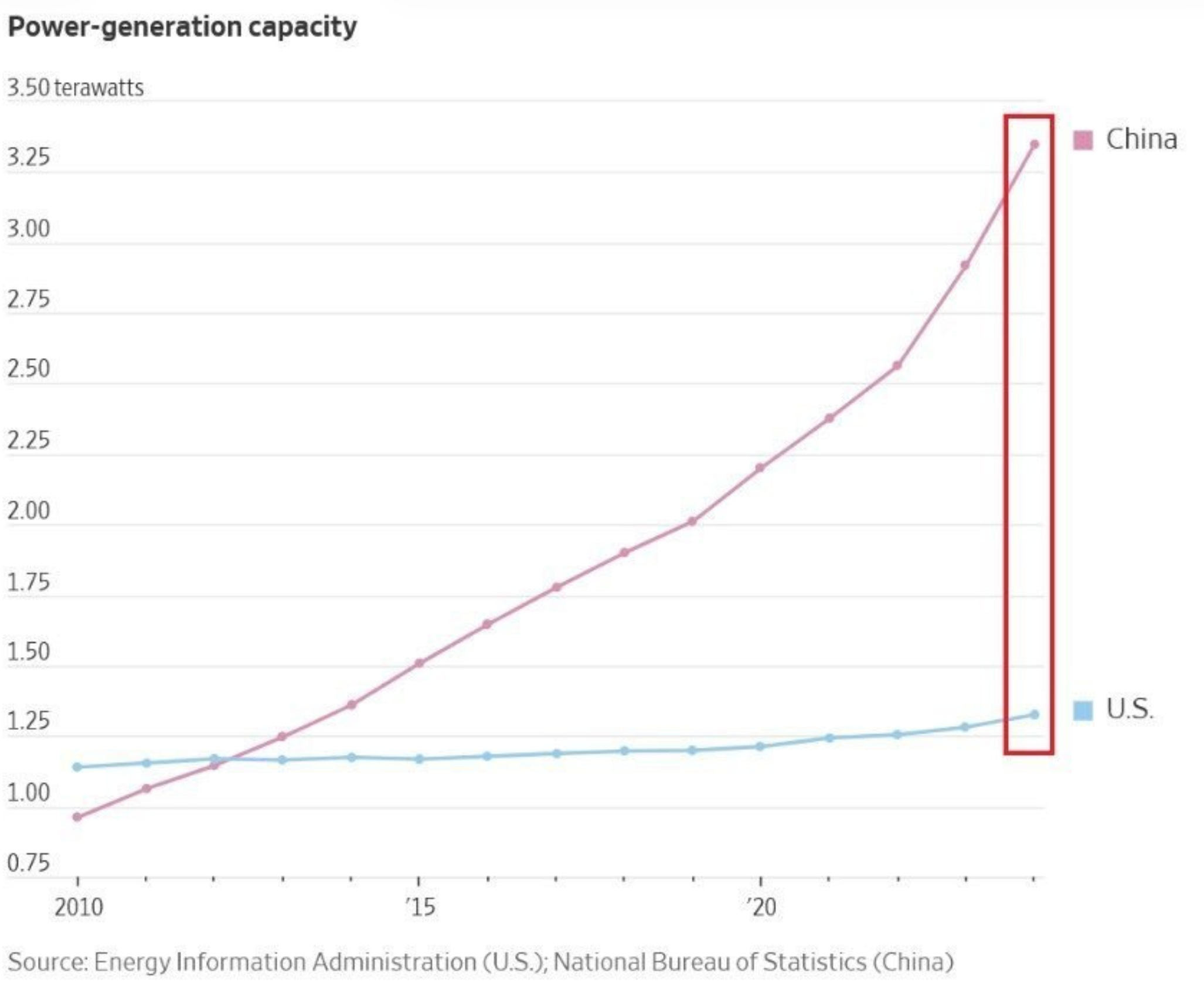
The U.S. has added capacity, yes, but our total generation has been relatively flat for a long time compared to the scale of what is coming. China is building generation, transmission, and industrial capacity like it expects to win the next century.
Now look at what the future actually demands.
AI and data centers.
Cloud services.
Always-on computing.
Electrified homes, heat pumps, and air conditioning.
Electric vehicles.
Smart devices everywhere.
Digital consumption replacing physical goods.
This is not just “technology.” It is electricity, at industrial scale, all the time.
China is planning for that demand. The U.S. is arguing about whether we should build anything at all.
“America Can’t Build” is a Pattern.
Housing is a mess. Infrastructure is a mess. Permitting is a mess. Every project becomes a decade-long fight.
High-speed rail in California is the perfect case study. It is not a train project anymore. It is a monument to dysfunction.
Honolulu rail is another. People have been talking about that project for decades. It turned into delay after delay and cost explosion after cost explosion. You do not even need to argue ideology. Just look at outcomes.
Then layer in NIMBY culture. Solar and wind projects get blocked. Transmission lines get blocked. New generation gets blocked. Nuclear gets blocked. We cannot future-proof our grid because we cannot agree to build anything that changes anyone’s view.
This is why the TSMC story matters. Taiwan’s semiconductor giant tried to build advanced fabrication capacity in the United States, and what did they run into? Red tape, labor shortages, skills gaps, cultural mismatch, and the slow grind of American bureaucracy.
That is not a one-off. That is a preview. If even a strategic, politically supported “national priority” chip plant becomes an obstacle course, what do you think the rest of reindustrialization looks like?
America’s Real Problem: We Can’t Build at Speed
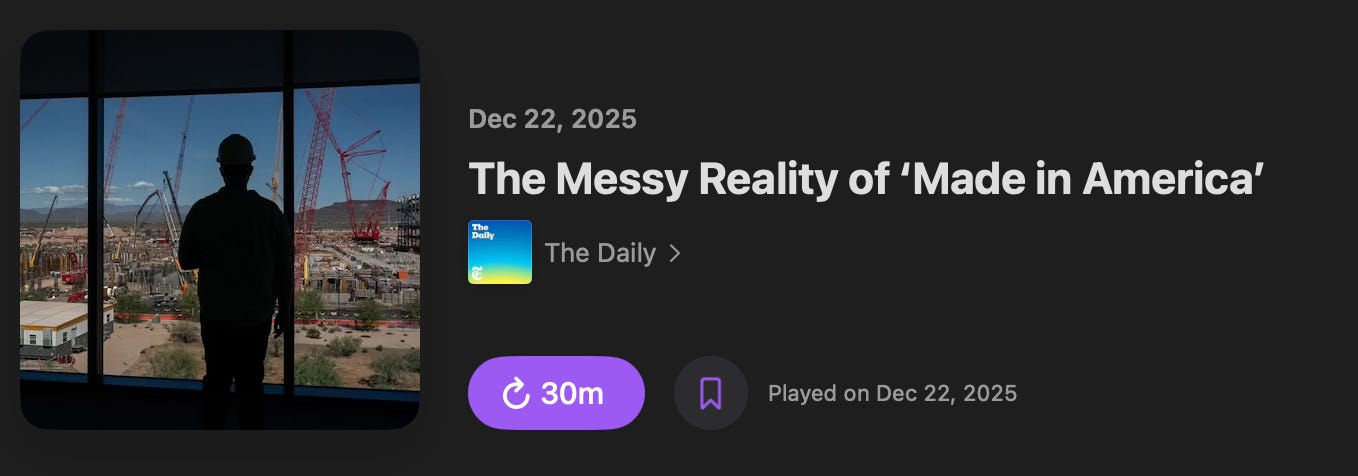
The episode from The Daily by the New York Times on TSMC’s Arizona chip facility perfectly captures the problem. On paper, this project was supposed to be proof that America could build again. A massive semiconductor fab, backed by federal subsidies, national security urgency, and bipartisan support.
And yet, what did it actually reveal?
Thousands of permits.
Years of delays.
Tens of millions spent just writing rules.
Labor shortages.
Skill gaps.
Cultural clashes.
Union disputes.
Lawsuits.
Community opposition.
Water fights.
Environmental reviews layered on top of each other.
In Taiwan, that same factory would have required one permit. One authority. One process.
In the United States, it required an entirely new regulatory universe to be invented on the fly.
Even for the most advanced chipmaker in the world, with billions in subsidies and political backing, building here was painfully slow and wildly expensive. The takeaway for every other company watching was not “America is back.”
It was “don’t try this unless you’re forced.”
That’s the signal we’re sending.
COVID Already Exposed the Cracks
None of this should be surprising. COVID showed us exactly how hollowed out our industrial base really is.
We couldn’t scale PPE production quickly. We didn’t just lack finished goods. We lacked the machines to make the goods. Hell, we lacked the machines that make the machines that make the goods! We lacked domestic supply chains. We lacked the workforce muscle memory.
That should have been a national alarm.
Instead, we treated it like a temporary inconvenience.
Yes, there were attempts to reshore. Yes, there were bills passed. But everything moved too slowly, got too complicated, and ran straight into the same barriers that stop every other large project in America.
Now Add Debt and Time
Rebuilding an energy and industrial base is not cheap and it is not fast.
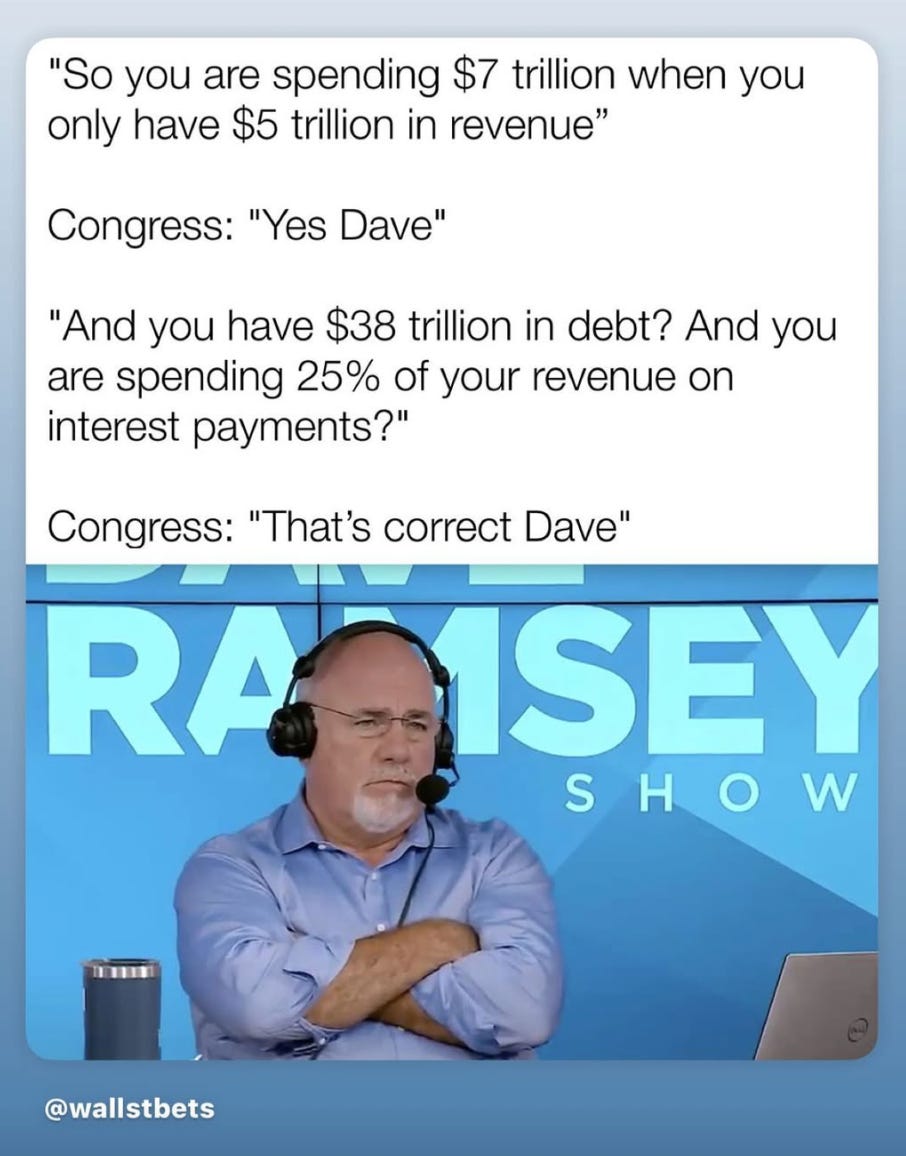
The national debt is in the tens of trillions. Annual deficits are routinely in the multi-trillion-dollar neighborhood. Interest costs are rising fast and are on track to become one of the biggest line items in the federal budget.
So when people say, “We should just build our way out of this,” I agree in principle. But in practice, we have boxed ourselves in. Financially, politically, culturally.
We do not have the timeline discipline. We do not have the permitting discipline. We do not have the workforce pipeline. We do not have the national consensus.
Which brings us back to Venezuela.
Why Venezuela Becomes “Viable” When Building Isn’t
Venezuela has massive oil reserves. It also sits in a world where strategic minerals and commodity leverage matter more every year.
China understands this. China is already using export controls and licensing regimes on key inputs. The broader rare earth conversation has been escalating for years. When major producers restrict supply, prices move, manufacturing gets squeezed, and entire industries become hostage to geopolitics.
So here is the choice the U.S. keeps making, whether we admit it or not.
Do we build?
Or do we take?
Building is hard. Slow. Expensive. Politically impossible. Litigation-prone. Culturally opposed.
Taking is something America already has an apparatus for.
The one industry we still dominate is not manufacturing. It is military power.
That’s the thesis, and I know it pisses people off. But look at the incentives and look at the outcomes. If you cannot build fast enough to stay competitive, you start securing access by force, by coercion, by regime pressure, by “operations.”
Capturing Maduro is not just about a person. It is a signal. It says Venezuela does not get full sovereignty when its resources intersect with U.S. economic needs. It says partnerships that box the U.S. out will be treated as a threat. It says the U.S. military will shape the conditions.
The Moral of the Story
Here is the blunt conclusion, and I’ll say it even if it pisses everyone off.
America currently cannot and is not build or compete in a way that is sustainable for the long term. Not in energy. Not in infrastructure. Not in manufacturing. Not in workforce development. Not at the scale needed for a world that runs on electricity, compute, and strategic materials.
So we fall back on what we still have.
The Military & The Military Industrial Complex
And if we keep refusing to build, keep refusing to permit, keep refusing to invest coherently, and keep treating every project like a moral crime, then we are going to do more of this. Not because it is noble, but because it becomes the only tool left that reliably works on the timeline politicians live in.
If you want fewer Venezuelas, the answer is not a prettier speech about peace.
The answer is building. Energy. Grid. Industry. Workforce. Execution.
Because if we don’t relearn how to do that, then yes, we will keep taking.
The Solution
