

Cathie Wood, the CEO of ARK Invest, has started to trim her bull case for Bitcoin. Her reason is simple: she believes stablecoins are going to take a large share of the digital money market. She is right to worry. Stablecoins are the biggest threat not only to sovereign money like Bitcoin but also to the entire idea of financial independence.

The New Company Store

Stablecoins are the modern company store. They are the 21st-century version of a corporation that issues its own vouchers and only accepts them within its own system.
Here is how it works. A company creates a digital token that is pegged to the U.S. dollar. People buy these tokens with real dollars. The company then invests those dollars into U.S. Treasury bills or other assets that earn interest. While customers hold the tokens, the company earns billions from that interest.
At the same time, they profit from every transaction that uses their coin. Every payment, every exchange, every bit of infrastructure built around that stablecoin earns them money. They can lend, invest, and speculate with the funds backing their token, all while promising stability.
That system is not decentralized. It is not freedom. It is the same as a company paying workers in its own currency and forcing them to spend it in its own stores. The only difference is that now it is digital.
The Most Profitable Businesses in History

The biggest stablecoin issuers are already among the most profitable companies in the world. Tether, which issues USDT, has earned more than six billion dollars in profit in a single year by investing its reserves in U.S. Treasuries. Circle, which issues USDC, and other firms in the space are generating enormous revenue simply by holding customer deposits and collecting interest.
Tether’s CEO Paolo Ardoino has publicly described the stable-coin model—where companies hold customer deposits, invest them in U.S. Treasuries or other assets, and collect the yield as one of the most profitable structures in modern finance.
He’s right.
These firms create a private monetary system in which they hold your cash, earn interest on it, charge fees on every transaction, and expand their control with every use of their coin.
Programmable Money, Programmable Control
Stablecoins are not neutral. They are programmable money. That means the issuer can decide where the money can be spent, who can spend it, and what it can buy.
Recently, Circle reversed a ban on using USDC for firearm purchases after political backlash. That decision proves the point. The same technology that allows them to block a transaction can allow them to block anything else. It could be political donations, certain stores, or even organizations they disagree with.
This is not just about financial technology. It is about control. Imagine a world where every transaction is mediated by a private company that can decide what aligns with its corporate policies or its brand values.
Your money is no longer neutral. It becomes a subscription product. You are not holding dollars. You are holding tokens branded as Tether, Circle, or World Liberty Financial, each with its own rules and restrictions.
The Corporate Dollar
For years, people have warned about Central Bank Digital Currencies. They worried that a government-run digital dollar would be used to monitor and control spending. But the conversation has shifted. The real threat is now corporate digital money, created by private companies with almost no oversight.
At least the government answers to voters and lawmakers. Private corporations answer only to shareholders.
These companies issue tokens that mimic the dollar, collect billions in deposits, invest the money, and control the ecosystem built around their product. Think terms of service agreements. They can make policy decisions through code and legal terms of service instead of through Congress or public debate.
If left unchecked, stablecoins could turn the United States into a digital company town, where every purchase happens inside a system owned by corporations rather than citizens.
When Politics Meets Money
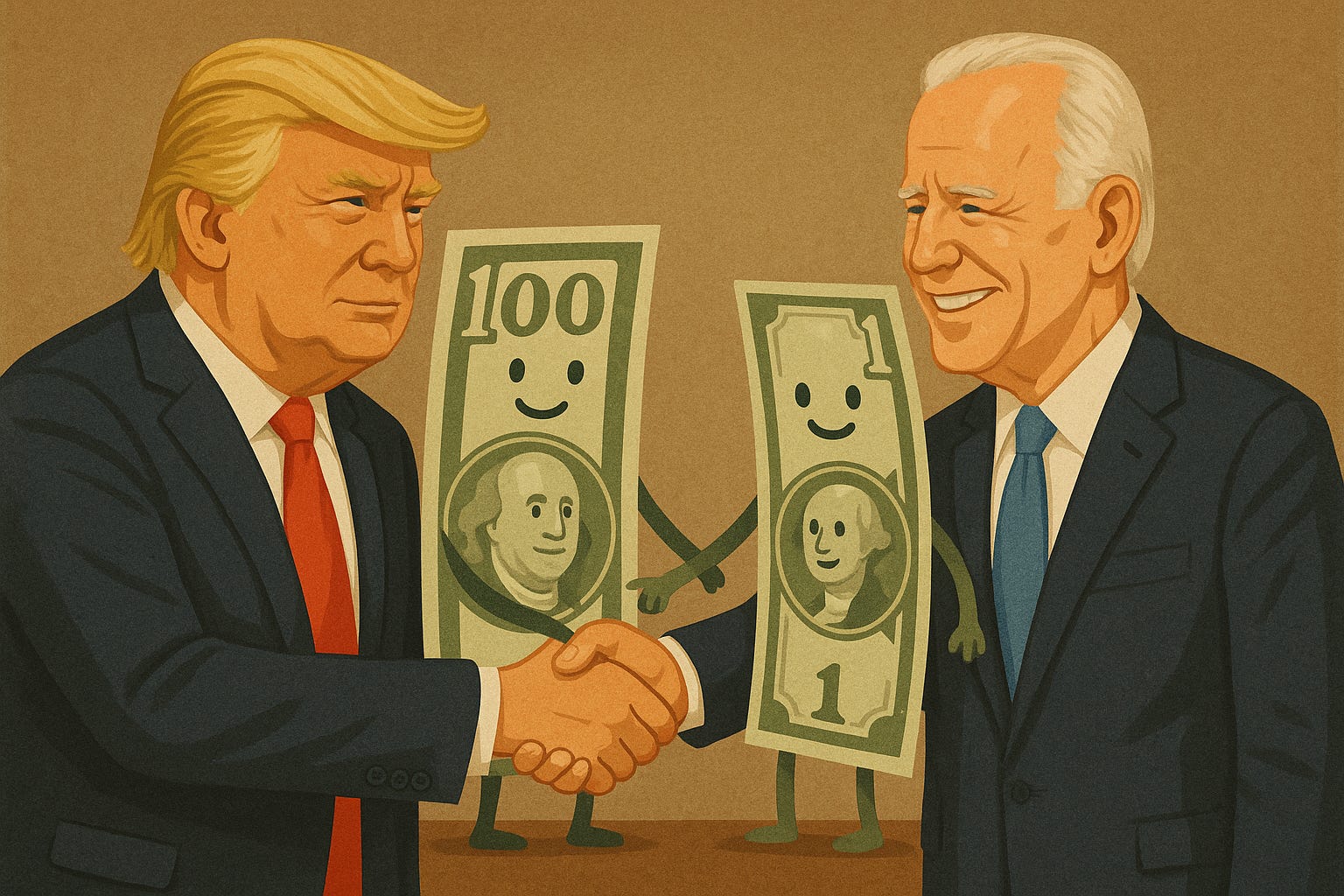
This is not hypothetical. Reports have already tied political figures and former administration allies to emerging stablecoin ventures such as World Liberty Financial, a company linked to pro-Trump networks that has discussed launching its own token. Binance, under former CEO Changpeng Zhao, reportedly invested billions in stablecoin projects around that same time.
If those connections are accurate, then political power and monetary power are now sitting at the same table. That is a massive conflict of interest. It is one thing when corporations control the market. It is another when the people writing or influencing policy are financially invested in it.
When the President of the United States, or anyone close to the executive branch, holds a stake in a private currency system, it crosses the line between governance and ownership. The question is no longer about innovation. It is about control.
The Slippery Slope Ahead
Stablecoins have exploded into a more than $300 billion market, with Tether alone surpassing $150 billion in circulation and Circle’s USDC holding around $70 billion. This is no small corner of crypto anymore — it’s the backbone of digital dollars, moving hundreds of billions every day and reshaping global finance in real time.
Tether and Circle dominate that space, but dozens of others are trying to break in. Each is building its own ecosystem. Each wants to become the foundation for digital dollars around the world.
The danger is simple. Whoever controls the token controls the rules. They control the data. They control the profits. And eventually, they control the policy.
This is not the free market. It is not capitalism as most Americans understand it. It is the privatization of money itself.
The Lesser of Two Evils
Ironically, the same people who once feared government control may have to decide that government oversight is the lesser of two evils. At least with a government-issued digital currency, there are laws, elections, and public accountability. Oh, and yeah… also this little thing we call the consitution. With private stablecoins, the terms of service are the law.
We are facing a world where “money” is a product and “freedom” is whatever the company allows.
The Warning
The line between technology and monetary sovereignty is fading. Stablecoins are not just an alternative payment method. They are the foundation of a private monetary system that could make corporations richer, governments weaker, and citizens more dependent than ever.
If we do not recognize that now, it will be too late to reclaim what was once the simplest idea in America: that money should serve the people, not the company that issues it.
You are entirely right except for the fact that you are entirely wrong about the fundamental premise: The Federal Reserve Banking Corporation is a private corporation, that puts out private money. There are two kinds of bank notes, so called Green ones put out by the Fed, and so called Red ones, put out by the Treasury Department. They are clearly marked on the notes.
The green ones are debt instruments, the red ones are not, they are either backed by silver, gold or the United States Armed Forces.
The private money problem, company store or not, goes back to 1913, not 2025.
The last US President to print "red backs" was JFKennedy. It did not end too well for him.