
Immigration Is a System, Not a Slogan
Labor demand, selective enforcement, and political theater

There is a lot of talk right now about immigration, and to be perfectly honest, it is exhausting.
What I know for certain is that most of the people having this conversation have never been immigrants, have never employed immigrants, and have never had to live under another country’s immigration system. They are arguing from vibes, feelings, and slogans, not experience.
So I want to share mine.
I lived as an immigrant in China and Taiwan for more than a decade. When Americans, Europeans, or Australians do this, we like to use the word expat. That word is a lie. It is a class distinction meant to make people feel better about themselves.
I was an immigrant.
I lived six years in Beijing, seven years in Shanghai, two years in Taiwan, and spent time in Hong Kong. Some of that overlapped with finishing my undergraduate degree while bouncing between Hawaii and Beijing, but most of it was consecutive. China was home.
I went there for opportunity. I went there for quality of life. I should probably write an entirely separate piece on what quality of life actually means and why I eventually came back, because it is not what people imagine. Some of it is explained here:

How the System Actually Worked
While I was there, I worked in upper management in hospitality. I ran hotels, nightclubs, restaurants, and lounges, sometimes all under one roof. One venue on busy nights, we employed hundreds of people, with full-time staff in the triple digits.
The workforce was a mix of locals and foreigners. Some were fully documented. Some were not. Some were in gray areas that everyone understood but few spoke about directly.
This was not unique to one venue or one city. It was how the industry functioned.
That is not a moral defense. It is a description of reality.
Everyone Knew the Rules
I have never entered a country without a visa. I have also lived in environments where it was widely understood that many people overstayed visas, worked outside their authorization, or existed in legal gray zones.
If you live inside immigrant communities abroad, this is not hidden. People know who is documented and who is not. Employers understand the risks. Governments understand what is happening.
Enforcement is selective, political, and often theatrical.
That does not make it right. It makes it predictable.
Early on, I observed how informal employment worked in sectors like education. Foreigners were hired because they were foreigners. Parents paid more for a foreign face speaking English. Schools paid cash. Everyone understood the arrangement.
The authorities understood it too.
China wanted growth. China wanted English literacy. China wanted foreign participation. So a blind eye was often turned.
Every so often, there would be visible enforcement. Immigration officials would show up. When that happened, schedules changed. People stayed home. Classrooms were rearranged. The director of our act said “action” for our preplanned choreography.
This was not chaos. It was theater.
The “Wild West” Phase
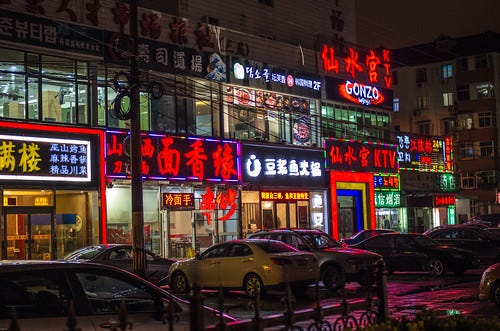
When I first arrived in China, it was still the tail end of what many foreigners referred to as the Wild West.
In certain foreign districts, visa services operated openly. Shell companies existed to sponsor foreigners. Documents were created, altered, or supplemented to fit requirements. If you wanted a visa, they would pull out a menu of visas to choose from. If you got in trouble and had enough money and connections, problems could often be “solved.”
Eventually, China tightened the system. At the same time, it expanded formal visa pathways, especially for degree holders.
Many skilled workers still fell through the cracks. Chefs. Bartenders. Hospitality managers. Security professionals. People who were excellent at their jobs but did not meet formal credential requirements. So documents were forged for them. Diplomas were Photoshopped. Papers were submitted.
The result was not confusion. It was aligned incentives.
Everyone understood the risk. Everyone understood the game.
The rules were simple. Do not get caught.
When Enforcement Came
I have personally experienced how unforgiving enforcement can be when it does arrive.
On one occasion, I had a valid visa that was deemed unacceptable because the visa was torn. There was no appeal process. No discussion. A decision was made, a phone call placed, and I was put on the next outbound flight.
The destination did not matter beyond whether I could enter that country without a pre-approved visa.
That is how I ended up in South Korea.
No one asked if I has a place to stay, if I could speak the language, if I even had any money for all of this, which I did (thank you student loans).
The priority was removal. Nothing else.
And there I was in Seoul.
Raids Were Real
I have seen immigration raids in nightlife venues.
Immigration would storm the venue: 20 - 30 of them jumping out immigration vans.
Music cut. Lights up. Officers spreading out in the venue. Passports demanded.
Illegal employees blended into crowds. Changed out of uniforms. People disappeared into bathrooms or slipped out exits and ran for it.
If documents could not be produced, names were taken. Sometimes people were told to report later. Sometimes they were detained immediately.
I have seen people removed the same night.
There were no lawyers. No advocacy groups. No procedural theater.
If you were caught, you paid the fine, you were removed, and if you were fortunate, you were allowed to return months later.
Your family? They didn’t care. Your school? Should have thought about that before. People were disappointed. But, nobody was shocked.
These Were Not Tourists
This is another lie people tell themselves.
These were not just tourists trying to stay an extra three months.
These were students who had been in China four, six, eight years. People doing master’s degrees. Doctorates. Medical residents working security at night. People who grew up in the Chinese school system from their teenage years. People with spouses. People with kids. People who had lived there for decades. They were good people.
They were also knowingly breaking the law.
Those things are not mutually exclusive. Complicity Was Everywhere.
Employers were complicit. Officials were complicit. Police were complicit. Communities were complicit. Foreigners were complicit. Everyone knew the rules.
We knew when immigration was coming. Sometimes the warnings were real. Sometimes they were wrong. Sometimes plans changed. But when the call came, people disappeared from their posts, blended into the crowd, or stayed home.
If they got caught, the business paid a fine and they got deported. That is how the system worked. The guilt was broad. The responsibility, however, always landed on the individual when enforcement came.
Why I Am Telling This Story
I am telling this because American immigration discourse is usually built on regurgitated narratives and no experience.
One side pretends laws do not matter if intentions are good.
The other pretends the enforcement is clean, moral, and orderly.
Both are lying.
Immigration systems are messy. They are driven by labor demand, selective enforcement, incentives, corruption, and politics. People understand the rules. They make choices. Sometimes they succeed. Sometimes they lose.
I have seen people thrive for years. I have seen people lose everything overnight.
The one thing I never saw was surprise.
Everyone knew their role. And damn did I see some Oscar winning performances.
A Necessary Clarification About America Today
Nothing in this is an endorsement of current ICE practices in the United States.
It is not an endorsement of masked agents, detaining Americans, or the stories circulating right now about abuse or overreach.
This is not a defense of cruelty.
This is not a call for authoritarian policing.
This is not a justification for lawlessness.
This is simply my lived experience as an immigrant under a different system, offered to puncture the fairy tales dominating this conversation.
We cannot fix what we refuse to describe honestly.
Disagree with me if you want. Argue with me if you want.
But stop pretending immigration is simple, clean, or morally pure on either side.
"All Americans, not only in the states most heavily affected but in every place in this country, are rightly disturbed by the large numbers of illegal aliens entering our country. The jobs they hold might otherwise be held by citizens or legal immigrants. The public service they use impose burdens on our taxpayers." -President Clinton in 1995.
He was correct then and now.