
Chinese ICE Raids
Reflections on Immigration and Enforcement: We Were Not Surprised

With ongoing debates surrounding deportation and immigration control in the United States, I recently found myself reflecting with friends on my own experiences living in China. I resided in China from 2004 to 2017, spending the latter half of that period, from 2010 to 2017, in upper management positions within the hospitality industry. My roles ranged from Director of Operations to Assistant General Manager, General Manager, Director of Food and Beverage, and Restaurant Manager—I had done it all.
Having spent so many years living and working in China, I could be considered an immigrant myself. Like any other foreign worker, I had to navigate the complex process of securing a visa. However, for every work visa our company successfully issued, there were likely two employees working without proper documentation. As a foreigner in China, I found myself in a position where I was both dependent on and responsible for individuals who were, by all legal definitions, working illegally.
The Evolution of China's Visa Policies
When I arrived in China in 2004, Hu Jintao was president, and the country was far more open to the West. At the time, people freely accessed international communication platforms such as MSN Messenger, Google, YouTube, Facebook, and MySpace. However, as the 2008 Beijing Olympics approached, China began systematically restricting these platforms. Eventually, the government implemented the Great Firewall, severing access to most Western websites and replacing them with domestic alternatives: YouTube was replaced by Youku, Skype by QQ, and Twitter by Weixin (WeChat).
This tightening of control extended beyond cyberspace and into immigration policy. Early on, securing a visa was relatively simple. It was common for tourists to extend their visas with ease, and for those seeking longer stays, enrolling in a local language school could secure a student visa for as little as $100. A thriving industry of visa service shops also emerged, working in tandem with shell companies that "employed" foreigners on paper, allowing them to obtain work visas without being tied to an actual employer. In practice, this meant that many foreigners were legally registered under fraudulent employers while working elsewhere.
Over time, the Chinese government cracked down on these loopholes. The process of obtaining fraudulent visas became more difficult, and many individuals either overstayed their visas or continued working without proper authorization. My workplace, like many others, employed a significant number of undocumented foreign workers. Our staff included security personnel, dancers, waiters, bartenders, and event coordinators, many of whom lacked the legal status to work in China.
Evasion and Enforcement: A Game of Cat and Mouse
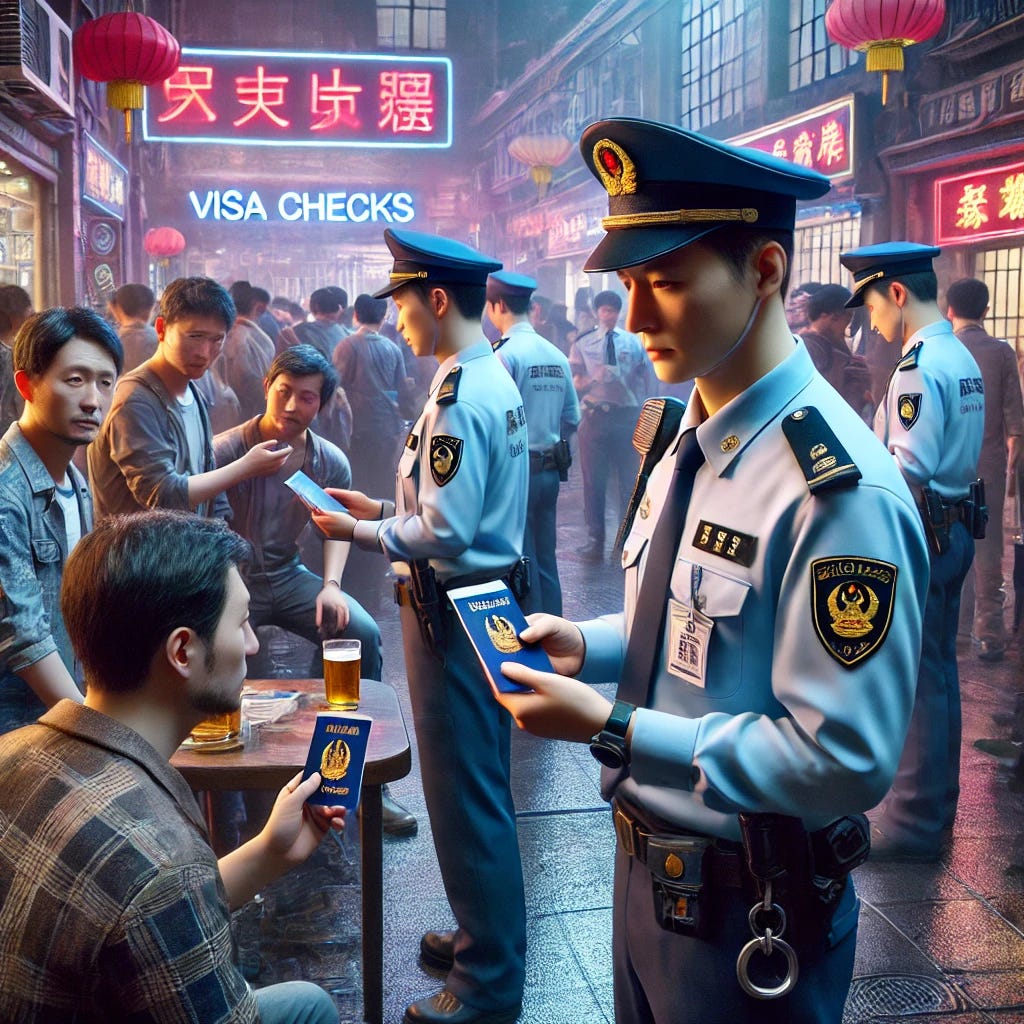
Part of managing a business in this environment meant staying vigilant for police or immigration officials conducting surprise inspections. Immigration officers would frequently enter our venues unannounced, ordering the music to stop, the lights to be turned on, and, with a crowd of over a thousand people inside, proceeding to check everyone's visas. If we spotted officers approaching from the street, we would use our radios to alert foreign staff. Employees working without legal status would quickly step away from their posts, grab a drink, and attempt to blend in as customers. Some of them weren’t even employed illegally but had simply overstayed their tourist visas—an offense that could still result in immediate arrest.
In the early days of enforcement, bribery was a common means of circumventing these issues. If an employee was arrested, they would be taken to the police station or immigration office, where a discreet payment would usually secure their release, allowing them to return to work the following night. However, this system collapsed when Xi Jinping consolidated power. Under his leadership, immigration laws were strictly enforced, and corruption was aggressively targeted. At that point, getting caught no longer meant a minor inconvenience—it meant immediate deportation, with no opportunity for negotiation.
I personally experienced China's rigid enforcement policies when I was deported for having a torn visa. Upon arriving at the border, officials immediately denied my entry and put me on the next flight out—to South Korea. I was not given a choice in the matter; I was simply placed on the first plane headed to the nearest country where I did not require a visa. From there, it was up to me to figure out how to either return to China or travel elsewhere.
The Reality of Working Illegally in China
I encountered many foreigners navigating similar situations. One individual, whom I will not name for privacy reasons, was a medical student from an African country. He worked as security at my venue while completing his residency. Though he was legally in China on a student visa, he needed income to survive. The dilemma was clear: he could work illegally and afford to live, or he could strictly follow the rules and struggle to get by. Every time immigration conducted an inspection, he was terrified that his dreams of becoming a doctor would be permanently derailed. He knew the risks, yet he also understood that he had no real alternatives.
On the other hand, not all cases were as sympathetic. I once hired two Austrian employees to work at the bar. The day before their visa interviews, they decided to go out drinking and partying. They showed up to their appointments reeking of alcohol, prompting immigration officers to administer a drug test. When they tested positive for cocaine, they were promptly denied entry into the country. China gave them a few days to pack their belongings, but ultimately, they were permanently barred from returning. They were fortunate not to have been arrested outright. Unlike the medical student who was merely trying to survive, these individuals knowingly made reckless choices.
Perspectives on Immigration Enforcement
Having been both an immigrant and an employer of undocumented workers, I developed a nuanced understanding of immigration enforcement. I had to navigate bureaucratic hurdles to secure my own legal status while simultaneously hiring individuals who were working illegally. Everyone in this situation, myself included, understood the risks. If caught, there was no room for outrage—only consequences.
The reality is that the only people who are surprised by immigration enforcement are those who have never had to deal with it firsthand.
Employers like myself were never shocked when we were fined or reprimanded for hiring undocumented workers. It was an open secret, an unavoidable reality of doing business. Foreigners seeking employment weighed the risk of working illegally against their financial needs, while employers assessed the likelihood of getting caught. When someone was deported, it was unfortunate, but never unexpected.
The two stories I shared illustrate the stark contrast in circumstances: one individual worked illegally out of necessity, while another failed due to carelessness. If the medical student had been deported, I would have felt deeply sympathetic. However, he likely would have been able to negotiate a resolution that allowed him to complete his studies. The Austrians, on the other hand, had no such recourse. They made reckless choices and faced the inevitable consequences.
Final Thoughts: The Balance Between Enforcement and Opportunity
I did not set out to write this as a call to action, but rather as an account of my personal experiences with immigration enforcement over 15 years in China, as well as additional time navigating visa regulations in Taiwan, Hong Kong, and Singapore. If there is one key takeaway, it is that enforcement is rarely a surprise to those directly affected by it.
I hope the United States develops an immigration system that distinguishes between individuals who contribute to society and those who do not. There are people like my African friend who work hard and pursue meaningful careers, and then there are people like the Austrians who make foolish decisions. The U.S. should enforce its immigration laws, but it should also recognize the value of those who genuinely contribute. Deporting someone for a visa violation should not permanently close the door on their return if they are willing to follow the proper legal channels.
China, in contrast, took its immigration policies too far. Over time, the country became more nationalistic and xenophobic, which ultimately harmed its economy and international appeal. Many foreign businesses closed, expatriates left, and cities such as Beijing, Shanghai, and Shenzhen lost their vibrancy. Tourism declined, and overall, China became a less dynamic place. I would hate to see the United States follow that path—becoming a country where foreigners no longer feel welcome or see opportunities.
There must be a balance between enforcing immigration laws and fostering an inclusive, prosperous society. A nation should have a strong national identity, but it should also embrace those who seek to contribute and build a better future.